
Game Is Hard Level 174 Solution Walkthrough & Answer
How to solve Game Is Hard level 174? Get instant solution & answer for Game Is Hard level 174: "A tree of numbers."
Doesn't look like your level?
App updates can sometimes shuffle the order of puzzles. If this level 174 walkthrough doesn't match your screen, don't worry! You can browse our All Levels guide to find your exact puzzle by its picture.
Quick Answer for Game is hard Level 174 (Do This)
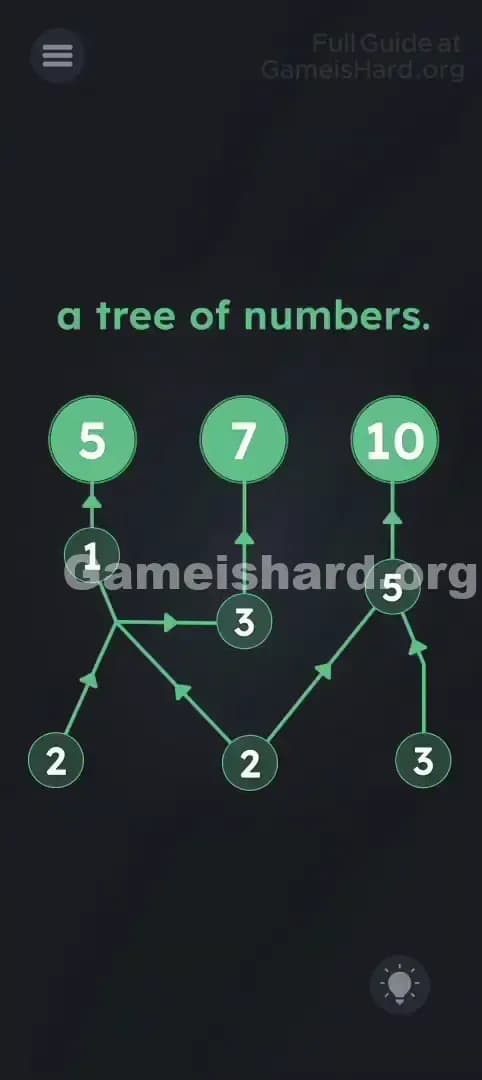
Solution: Drag the loose numbers into the empty circles in this specific arrangement:
- Bottom Row (Left to Right): 2, 2, 3
- Middle Row (Left Circle under the 5): 1
- Middle Row (Right Circle under the 10): 5
Target: Place them carefully; the numbers must snap into the circles to register the sum.
Game is Hard Level 174 Overview
The Hook of Game is hard Level 174
You open the level and it looks like a nightmare from high school algebra. You’ve got a "tree of numbers," arrows pointing everywhere, and a bunch of loose digits floating around like fridge magnets. It feels less like a puzzle and more like a flowchart for a chaotic business plan. The immediate frustration isn't just the math—it's figuring out which circle feeds into which top number.
The Objective of Game is hard Level 174
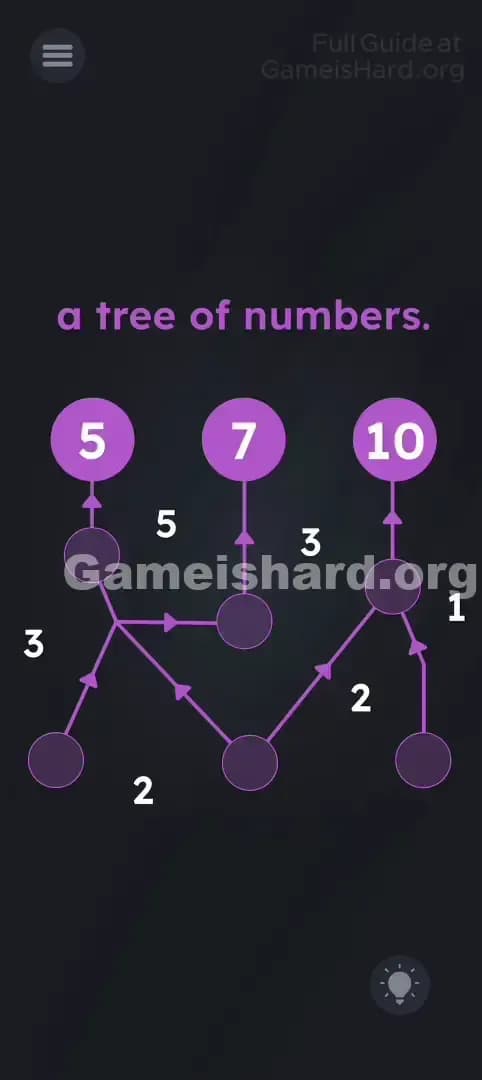
Your goal is to populate the empty purple circles so that the math works out for the top row (5, 7, and 10). This is a "sum-tree." Every parent node (the ones higher up) is the total sum of the numbers directly connected below it. You aren't answering a question; you are building the equation that makes the answer true.
The Mechanics at Game is hard Level 174
- Drag and Drop: You have to physically move the numbers 1, 2, 2, 3, and 5 into the slots.
- Logic Puzzle: This is a dependency graph. Changing a bottom number affects multiple top numbers simultaneously.
- Visual Tracing: The lines are the key. You have to trace the faint purple arrows to see which bottom circles feed into which top circles.
It’s not random. Every arrow is a plus sign.
What You See on Screen in Game is hard Level 174
The screen is dark with a purple theme. At the very top, you have three large fixed circles containing the "target" sums: 5, 7, and 10.
Below them is a web of connections:
- Middle Row: Two empty circles. One is positioned generally under the 5, and one is under the 10.
- Bottom Row: Three empty circles spread horizontally.
- Arrows: Lines with arrows connect the bottom circles to the middle ones, and the middle/bottom ones to the top targets.
- Loose Numbers: Scattered around the screen are five numbers: 1, 2, 2, 3, 5.
It looks like a circuit board, and if you don't trace the lines first, you're just guessing.
What’s Tricking People in Game is hard Level 174
The "Ghost" Node (The 7)
The biggest trap here is the number 7. Players frantically look for a middle circle directly under the 7 to place a number into. There isn't one. The top circle "7" doesn't have its own dedicated feeder node in the middle row. It draws its value entirely from a combination of the other nodes. If you try to solve for 7 first, you’ll fail because you can't place a number "for" 7 directly.
The Overlap Confusion
The arrows cross-pollinate. The bottom-middle circle, for example, feeds into the left side and the right side. This means whatever number you put in the bottom-middle slot counts towards all three top totals. Most players assume each column is independent. They try to solve the "5 column," then the "10 column." You can't do that. It's a single interconnected system.
My Reaction
I spent two minutes trying to drag the number 7 itself. I thought, "Maybe the tree is wrong, and I need to move the answer?" Nope. The UI is rigid. The only things that move are the small loose numbers. I felt pretty silly once I realized I was overcomplicating a simple addition problem.
Game is hard Level 174 Step-by-Step Walkthrough
The Setup of Game is hard Level 174
Ignore the middle row for a second. The most important placement is the Bottom Middle circle because it connects to almost everything. If you get that wrong, the whole tree breaks. Let's build from the bottom up.
The Action in Game is hard Level 174
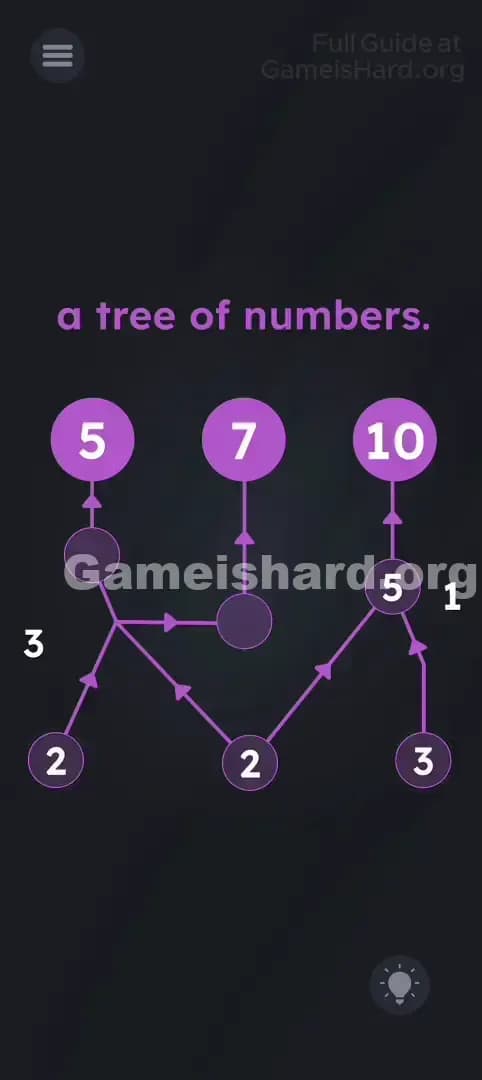
Step 1: The Foundation (Bottom Row) The bottom row determines the base values.
- Drag a 2 into the Bottom Left empty circle.
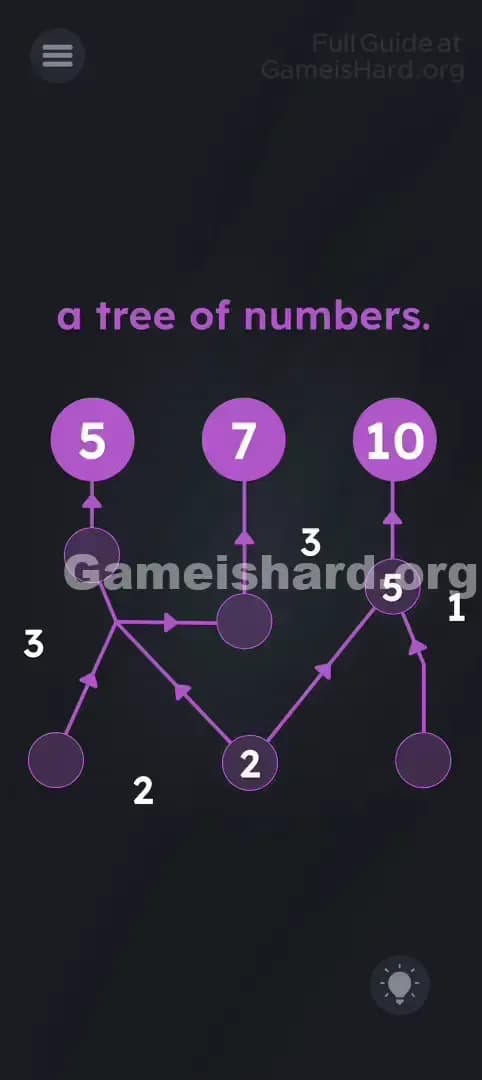
- Drag the other 2 into the Bottom Middle empty circle.
- Drag the 3 into the Bottom Right empty circle.
Verification: At this point, the middle sum (7) should theoretically be satisfied because 2 + 2 + 3 = 7, and the arrows from the bottom row all eventually feed toward the center path.
Step 2: The Connectors (Middle Row) Now you have two numbers left: a 1 and a 5. You need to bridge the gap to reach the targets of 5 and 10.
- Drag the 1 into the Middle Left circle (the one sitting under the top 5).
- Why? The top needs to be 5. The bottom nodes (2 and 2) sum to 4. You need 1 more. (2 + 2 + 1 = 5).
- Drag the 5 into the Middle Right circle (the one sitting under the top 10).
- Why? The top needs to be 10. The bottom nodes feeding this side are the middle one (2) and the right one (3). That’s 5. You need 5 more to hit 10. (2 + 3 + 5 = 10).
Step 3: The Check Once the final number snaps in, the lines should light up or the level will complete immediately. If it doesn't trigger, verify your positions against the list below.
Troubleshooting
- Numbers popping out: If a number refuses to stay in a circle, you aren't dragging it precisely enough. The hitbox is the center of the empty circle.
- Level not ending: You might have swapped the bottom numbers. Specifically, swapping the 3 and 2 on the bottom right/left might look okay for the sides, but it will break the middle sum of 7. Ensure the 3 is on the bottom right.
The Logic Behind Game is Hard Level 174
This level is a disguised lesson in system dependencies. In game design (and programming), this is a "directed acyclic graph" (DAG).
The game is testing your ability to spot the "Load Bearing" element. The Bottom Middle circle is the linchpin. Since it has arrows pointing to both the Left (5) and Right (10) branches, its value is counted twice (actually thrice, for the 7).
- Top 5 = Bottom Left + Bottom Middle + Middle Left
- Top 10 = Bottom Right + Bottom Middle + Middle Right
- Top 7 = Bottom Left + Bottom Middle + Bottom Right (The sum of the entire bottom row).
Once you realize the 7 is just the sum of the bottom row (2+2+3=7), the puzzle solves itself. The game hides this simple logic behind a messy visual web to trigger panic. It's not a math test; it's a test of whether you can filter out visual noise to find the root input.
Pro Tip for Game is Hard Level 174
If you are speed-running or replaying this level, use this mental shortcut: Big number goes to big number.
- Identify the biggest loose number (5).
- Identify the biggest target (10).
- The loose 5 must go to the branch feeding the 10.
- The smallest number (1) goes to the smallest target branch (5).
- Fill the bottom with the leftovers.
This heuristic (rule of thumb) works because puzzle games rarely make the math complex enough to defy basic size logic. Large inputs usually belong to large outputs.
FAQ of Game is hard Level 174
Why doesn't the middle top number (7) have a circle below it? The "7" is a passive sum. It doesn't have a direct "modifier" node like the 5 and 10 do. It acts as a checksum for the bottom row. If the bottom row adds up to 7, that part of the puzzle is solved automatically.
Can I swap the two 2s? Yes. Since both numbers are identical (values of 2), it doesn't matter which physical "2" object goes into the Bottom Left or Bottom Middle slot. The game code only checks the value, not the unique ID of the object.
Does order matter when placing them? No. You can place the top-middle ones first if you want, but it’s harder to calculate that way. It’s always easier to build from the "leaves" (bottom) up to the "root" (top).
I put the numbers in correctly but nothing happened. Tap the numbers again to "seat" them. Sometimes the game requires a slight nudge to register the collision. If that fails, restart the level—the logic engine might have hanged.
Get more level walkthrough on Gameishard.org
That’s how you solve the number tree without breaking out a calculator. If you found this guide helpful, we have hundreds more for every tricky puzzle this game throws at you. We cut the fluff and give you the answer straight. Check out the main page for more solutions!